 |
||||
|
 |
|
|
|
Click here to view all Upcoming Events// IFF Directors Talks
IFF Directors Talks 2012 // Previous IFF Lectures THE MOSELY SNOWFLAKE SPONGE THE ART OF ITERATION MAKING SPACE IFF Director Margaret Wertheim speaks at Art Center College of Design Captain Charles Moore Talks About Plastic Trash IFF Director Margaret Wertheim Seeing Anew [IFF-L20] Structural Considerations of the Business Card
Sponge[IFF-L17] Where the Wild Things Are 2: Things That Think: Where the Wild Things Are: Crocheting the Hyperbolic Plane: Darwinism on a Desktop: The Logic Alphabet Why Things Don't Fall Down Kindergarten: Crocheting the Hyperbolic Plane [IFF-L5] The Mathematics of Paper Folding [IFF-L4] The Physics of Snowflakes [IFF-L3] Crocheting the Hyperbolic Plane [IFF-L2] The Figure That Stands Behind Figures: // Previous Events Crochet Hyperbolic Workshop
|
The fifth in
our 2005 lecture series |
|||
 |
||||
|
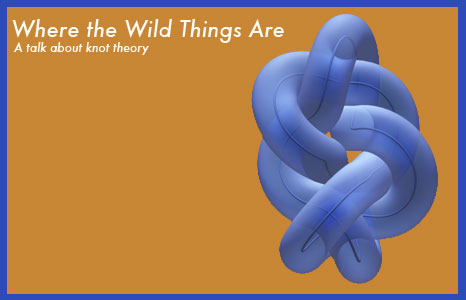
In mathematical lore, a topologist is a person who can’t
tell the difference between a coffee cup and a donut, both objects
being topologically the same. Of the many things topologists strive
to categorize, one of the more enigmatic is knots. Though knotting
is one of humanity’s oldest and most widespread activities,
being documented in almost every culture on earth, at first glance
it seems an unlikely subject for the formalisms of mathematics.
But at the end of the nineteenth century mathematicians began to
classify these twisted and braided forms, leading to a vast taxonomy
of the species, whose members include the unknot, ideal knots, tame
knots and wild knots. |
||||
 |
||||
As
an undergraduate at MIT, Ken Millett was first drawn to engineering,
then to physics, and ultimately to mathematics, specifically to
geometry and topology, because, he says “these have served
as the language of expression and means to study the mysteries of
the natural sciences.” In the 1980’s Millett was involved
in the discovery of several classes of “knot invariants,”
polynomial equations that help mathematicians to categorize knots,
and he participated in the development of topological quantum field
theory. He is currently working on applying knot invariants to questions
arising in molecular biology, including the structure of DNA. At
the other end of the scale, models arising from these methods also
apply to solar storms. Dr Millett is an authority on polygonal modeling
of knots and is a leading researcher investigating the spatial characteristics
of knotted materials. |
||||
 |
||||
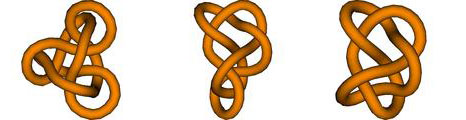
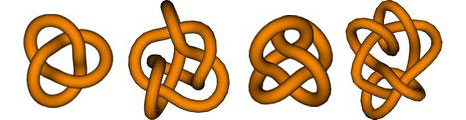
"Ideal
Knot" (top): courtesy of Ken Millett and Jason Cantarella Knot images (above): courtesy of Eric Rawdon and Michael Piatek (created using KnotPlot, a program for visualizing and exploring knots by Rob Scharein) |
||||
| © 2003–2018 The Institute For Figuring | ||||