 |
||||
|
 |
|
|
|
Click here to view all Upcoming Events// IFF Directors Talks
IFF Directors Talks 2012 // Previous IFF Lectures THE MOSELY SNOWFLAKE SPONGE THE ART OF ITERATION MAKING SPACE IFF Director Margaret Wertheim speaks at Art Center College of Design Captain Charles Moore Talks About Plastic Trash IFF Director Margaret Wertheim Seeing Anew [IFF-L20] Structural Considerations of the Business Card
Sponge[IFF-L17] Where the Wild Things Are 2: Things That Think: Where the Wild Things Are: Crocheting the Hyperbolic Plane: Darwinism on a Desktop: The Logic Alphabet Why Things Don't Fall Down Kindergarten: Crocheting the Hyperbolic Plane [IFF-L5] The Mathematics of Paper Folding [IFF-L4] The Physics of Snowflakes [IFF-L3] Crocheting the Hyperbolic Plane [IFF-L2] The Figure That Stands Behind Figures: // Previous Events Crochet Hyperbolic Workshop
|
The
sixth in our 2005 lecture series |
|||
 |
||||
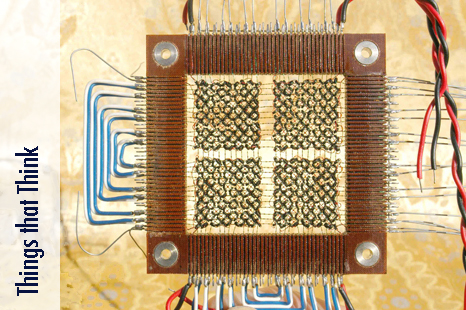
| "Core
memory" board from a 1960's mainframe computer. Photo by Nicholas Gessler |
||||
|
As we move into the age of ubiquitous computing, we are in danger
of forgetting how we first made things think and how things are
thinking today. Computation is increasingly hidden on chips, sealed
in plastic behind the stylish skins of our appliances, under the
sexy high performance hoods of our automobiles, and behind the sizzling
screens of our PCs, ATMs and cell phones. Information seems to have
lost its materiality as, increasingly, we envision it freely floating
in a global ether of wireless connectivity. |
||||
 |
||||
|
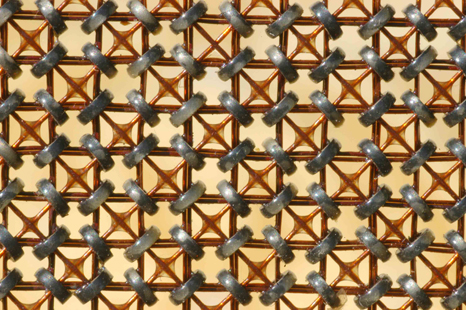
Close-up of core memory storage. Each "core"
is a small torus of ferromagnetic iron and holds one bit of data.
The cores here are 2.0 mm in diameter. Core memory, which is still
used in some satellites and deep space probes, is threaded like
beadwork and painstakingly made by hand, usually by women. Photo by Nicholas Gessler. |
||||
Nicholas
Gessler is a researcher at UCLA whose work focuses on the emerging
field of "artificial culture" - a research enterprise
that extends work which began with distributed artificial intelligence
and artificial life "towards a new practice of synthetic anthrolpology".
Originally trained in more traditional anthropological practices,
Gessler formerly studied the indigenous culture of the Queen Charlotte
Islands off the coast of Canada. From 1973-1988 he was director
and curator of the Queen Charlotte Islands Museums. In addition
to his work on social and cultural simulation, Gessler is an expert
on, and avid collector of, early computational devices. His collection
includes a vast eclectic array of thinking mechanisms from a mid-nineteenth
century Jacquard loom to a still working module of Danny Hillis's
legendary supercomputer, the Connection Machine.
For more information about his collection of "Things That Think" see his website: http://www.sscnet.ucla.edu/geog/gessler/collections/ |
||||
| © 2003–2018 The Institute For Figuring | ||||