 |
||||
|
 |
|
|
|
|
The IFF and cabinet Crystal Clear: An Interview with
Shea Zellweger The Mathematics of Paper Folding: Crocheting the Hyperbolic Plane:
|
The Institute publishes books and brochures related to our exhibitions and other topics of interest. See here also for other beautiful IFF related materials. The bookstore is currently closed! Check back soon. |
|||
| All web orders processed securely via PayPal. | ||||

Now the world's largest participatory art and science project, the "Crochet Coral Reef" combines mathematics, marine biology, environmental consciousness raising and community art practice. Almost 8000 people around the world have helped to make these gorgeous woolen seascapes, which have been exhibited at the Hayward Gallery, the Smithsonian, and many other venues. This lavishly illustrated book, written by the project's creators - Margaret and Christine Wertheim - brings together the scientific content behind the project along with essays about the artistic and cultural relevance of this unique experiment in radical craft practice. The book serves as a record of the 30+ Crochet Reefs worldwide and names all 7000+ contributors in a specially designed section. |
Crochet Coral Reef - The Book by Margaret and Christine Wertheim Currently out of print | |||
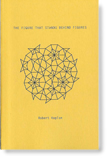
The first volume of the Institute’s in-house series of books inspired by IFF lecture topics. Based on our Inaugural Lecture in April 2003, The Figure that Stands Behind Figures is a charmingly erudite essay from mathematician Robert Kaplan about the history of figuration in Western culture. From the whimsical drolleries that encrusted the margins of medieval texts to the geometry of periodic and aperiodic tiling patterns, Kaplan traces the evolution of the “figure” in Western thought and challenges readers to discover for themselves the protean algebraic figure that stands in for all others. |
The Figure that Stands Behind Figures: by Robert Kaplan
|
|||
This elegant book provides an introduction to the subject of hyperbolic space and a how-to guide for making hyperbolic crochet models. The volume is a wonderful aid to the IFF's Hyperbolic Crochet Coral Reef project. For two thousand years mathematicians knew about only two kinds of geometry – the plane and the sphere. But in the early nineteenth century they became aware of another space in which lines cavorted in aberrant formations. Offending reason and common sense, this new space came to be known as the hyperbolic plane. Although the properties of this space were known for 200 years, it was only in 1997 that mathematician Daina Taimina worked out how to make physical models of it. The method she used was crochet. Here, IFF director Margaret Wertheim presents a brief history of hyperbolic space in mathematics and nature, and offers a "field guide" to its crocheted manifestations. An invaluable resource for those interested in the Hyperbolic Crochet Coral Reef. |
A Field Guide to Hyperbolic Space: |
|||
|
||||
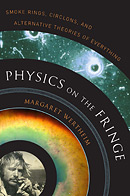
A new book by IFF Director Margaret Wertheim, exploring the geniuses, mavericks and outsiders who invent alternative theories of the universe. What drives a man with no science training to think he can succeed where Einstein and Stephen Hawking have failed? In 1993, Jim Carter, a trailer-park owner in Enumclaw, Washington, sent out to a select group of scientists a letter announcing the publication of a book in which he proposed a complete alternative theory of physics. Gravity and matter, the periodic table, and the creation of the universe – all these Carter explained through wildly creative ideas developed while working as a gold miner and abalone diver. He tested his theories through backyard experiments using garbage cans and a fog machine to make giant smoke rings. For the past fifteen years, Wertheim has been collecting the works of Jim Carter and other "outsider physicists,” many of them without formal training and all convinced they have found the true theory of the universe. By considering the motivations of men like Carter, with their do-it-yourself theories and homemade experiments, Wertheim raises the question of what role an amateur can play in relationship to science. Deeply human, literally fantastical, infused with wit and humor, Physics on the Fringe challenges our conception of what science is, how it works, and who it is for. ISBN 978-0-8027-1513-5 |
Physics on the Fringe: Smoke Rings, Circlons and Alternative Theories of Everything |
|||
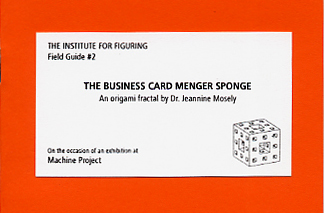
The third volume of the Institute’s in-house series of individually printed and hand-bound books inspired by IFF lecture and exhibition topics. Menger's Sponge - named for its inventor Karl Menger and sometimes wrongly called Sierpinski's Sponge – was the first three dimensional fractal that mathematicians became aware of. In 1995 Dr Jeannine Mosely, a software engineer, set out to build a Level 3 Menger Sponge from business cards. After 9 years of effort, involving hundreds of folders all over America, the Business Card Menger Sponge was completed. The resulting object is comprised of 66,048 cards folded into 8000 interlinked sub-cubes, with the entire surface paneled to reveal the Level 1 and Level 2 fractal iterations. In conjunction with the IFF curated show at Machine Project gallery, the Institute presents this handsome Field Guide to the Business Card Menger Sponge. Learn how to fold cubes yourself and make your own business card sponges! Fun for all the family. Perfect as gifts - and educational too. This book is individually hand-made at the Triage Bindery. |
Field Guide to the Business Card
Menger Sponge Currently out of print |
|||
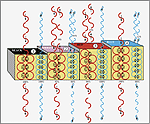
This item is the Catalog Pack of The Institute’s first exhibition, “Lithium Legs and Apocalyptic Photons: The Imaginative World of James Carter”, held at the Santa Monica Museum of Art (2002). Carter, a former abalone diver and gold-miner, has created an entire alternative theory of physics from the subatomic to the intergalactic, a radically other vision of reality based on the concept of absolute motion and a new kind of particle that Carter terms the “circlon.” The pack contains a catalog essay booklet that accompanied the exhibition, plus a selection of images illustrating Carter’s alternative theory of everything. |
Lithium Legs and Apocalyptic Protons |
|||
|
|
||||
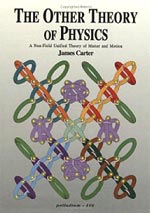
See the entire theory in a book written and published by James Carter himself. From his subatomic theory of circlons to his radical denial of gravity, Carter is never one to tow the line. Learn about “lithium legs,” “chromium crosses,” and “apocalyptic photons” so powerful a single one might contain the energy of a galaxy. The ultimate expression of outsider science, gorgeously illustrated throughout. |
The Other Theory of Physics by James Carter |
|||
|
||||
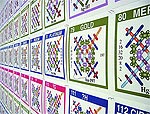
As part of his theory of physics, James Carter has conceived an alternative explanation for the atomic elements, in which each element is composed of a set of tiny interlocking rings called “circlons.” In Carter’s conceptualization, circlons fit together like subatomic Lego and build up naturally to form a pattern that matches the Periodic Table. This item is a handsomely produced wall chart, printed by Carter himself, that outlines his atomic theory. On the back is his alternative explanation for the creation of the universe. |
James Carter’s Periodic Table of Elements |
|||
An idiosyncratic documentary about an idiosyncratic man, the film follows outsider physicist James Carter, tracing the development of his radical alternative theory of the universe. Complete with animations Jim created to demonstrate his ideas about the structure of atoms and the formation of the universe, plus dreamy 1970's footage of his life as a gold-miner and his work on the Bellagio Fountains in Las Vegas, this phantasmagorical portrait is at once intimate and cosmic. By IFF Director Margaret Wertheim and Cameron Allan. |
It's Jim's World... We Just Live In It |
|||
|
||||
| © 2003–2018 The Institute For Figuring | ||||