 |
||||
|
 |
|
|
|
Click here to view all Upcoming Events// IFF Directors Talks
IFF Directors Talks 2012 // Previous IFF Lectures THE MOSELY SNOWFLAKE SPONGE THE ART OF ITERATION MAKING SPACE IFF Director Margaret Wertheim speaks at Art Center College of Design Captain Charles Moore Talks About Plastic Trash IFF Director Margaret Wertheim Seeing Anew [IFF-L20] Structural Considerations of the Business Card
Sponge[IFF-L17] Where the Wild Things Are 2: Things That Think: Where the Wild Things Are: Crocheting the Hyperbolic Plane: Darwinism on a Desktop: The Logic Alphabet Why Things Don't Fall Down Kindergarten: Crocheting the Hyperbolic Plane [IFF-L5] The Mathematics of Paper Folding [IFF-L4] The Physics of Snowflakes [IFF-L3] Crocheting the Hyperbolic Plane [IFF-L2] The Figure That Stands Behind Figures: // Previous Events Crochet Hyperbolic Workshop
|
The Mathematics
of Paper Folding [IFF-L4] Tuesday, October 26, 2004 @ 7:30pm Download the paper fold model Dr. Lang created for the IFF Cabinet Magazine interview with Robert Lang |
|||
  |
||||
| Dr. Robert Lang is one of the pioneers of the field of computational origami, the cross disciplinary marriage of mathematics and paper folding, sometimes known as origami sekkei or technical folding. Dr Lang is the architect of the TreeMaker computer program [more] that will design and calculate crease patterns for a wide class of origami models, including complicated insects, crustaceans and amphibians. He has been one of the very few Western columnists for the journal of the Japan Origami Academic Society and is the author of Origami Design Secrets: Mathematical Methods for an Ancient Art. Dr Lang has consulted on applications of folding to engineering problems ranging from air-bag design to expandable space telescopes. After a successful career in the field of laser physics and optoelectronics, he has recently become a full-time paper folder. In this lecture he will talk about the art and science of origami sekkei. |
||||
 |
||||
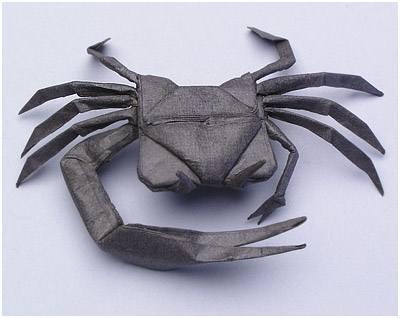
| Images: crab model | lecture hall | Dr. Lang | ||||
|
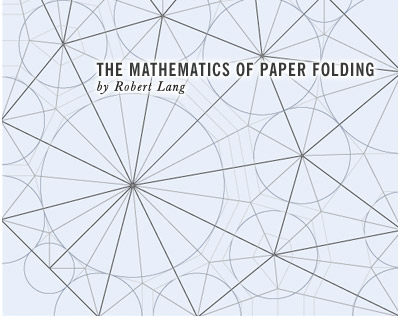
Traditional origami models, painstakingly developed by hand, have mostly been simple structures - stylistic “sketches” of birds and flowers, and pretty decorative boxes. The toolkit of the computational origamist vastly expands this repertoire through the techniques of mathematics, enabling the construction of elaborate geometrical models and startlingly realistic animals with detailed anatomical features such as wings and claws and antennae. One of the major hurdles for the technical folder is to solve what is known as the circle-packing problem. If, for example, you want to make a lobster, which has a dozen or more different parts, how do you assign the space on the paper so that all the parts are accommodated? It turns out that mathematically this is equivalent to the long-standing problem of how can one efficiently pack a bunch of circles into a square. Though trivial to state, mathematicians do not have a general solution to this question and can only solve it for around two dozen circles. Fortunately that is good enough for most origami challenges. Dr Robert Lang’s Treemaker program will compute the circle-packing solution for a wide range of models and design the pattern of creases to define the desired form. |
||||
| Download this paper fold model Dr. Lang created for the IFF* *PDF download: requires Adobe Reader or Apple Preview |
||||
| © 2003–2018 The Institute For Figuring | ||||