 |
||||
|
 |
|
|
|
Click here to view all Upcoming Events// IFF Directors Talks
IFF Directors Talks 2012 // Previous IFF Lectures THE MOSELY SNOWFLAKE SPONGE THE ART OF ITERATION MAKING SPACE IFF Director Margaret Wertheim speaks at Art Center College of Design Captain Charles Moore Talks About Plastic Trash IFF Director Margaret Wertheim Seeing Anew [IFF-L20] Structural Considerations of the Business Card
Sponge[IFF-L17] Where the Wild Things Are 2: Things That Think: Where the Wild Things Are: Crocheting the Hyperbolic Plane: Darwinism on a Desktop: The Logic Alphabet Why Things Don't Fall Down Kindergarten: Crocheting the Hyperbolic Plane [IFF-L5] The Mathematics of Paper Folding [IFF-L4] The Physics of Snowflakes [IFF-L3] Crocheting the Hyperbolic Plane [IFF-L2] The Figure That Stands Behind Figures: // Previous Events Crochet Hyperbolic Workshop
|
The Institute
for Figuring Friday, May 20 @ 8:00pm Telic [ more
] |
|||
  |
||||
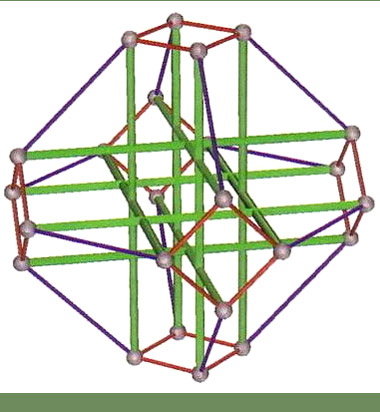
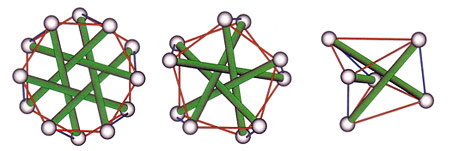
| Tensegrity images courtesy of Robert Connelly and Allen Back. | ||||
| In the autumn of 1948, while experimenting with ways to build flexible modular towers, a young artist named Kenneth Snelson constructed a sort of sculpture that had never been seen before. Etheral in appearance and with no obvious weight-bearing elements, it nonetheless retained its shape and stability. The following summer Snelson showed the enigmatic form to his mentor, R. Buckminster Fuller, who had been thinking about the possibilities of structures held together by tension. Fuller adopted Snelson’s invention as the centerpiece of his system of synergetics and, acknowledging its integrity under tension, gave it the name tensegrity. Made up of two types of elements called cables and struts - which may be modeled with rubber bands and pieces of dowel - tensegrity structures embody a balance of tensional and compressional forces. Cables pull vertices together; struts hold them apart. Tensegrities may be seen in such diverse manifestations as cabled roofs, robot arms, the folding of proteins, the packing of granular materials, the internal structure of glass, and the architecture of living cells. A spider web can also be viewed as a tensegrity, albeit one with no rigid parts. In the 1970’s mathematicians began a general study of tensegrities, creating a theory with special regard to their geometry. In this lecture Dr. Robert Connelly will discuss tensegrities from spider webs to the carpenters rule and explore the underlying geometry of why things don’t fall down. The audience will be invited to build their own tensegrity structures. |
||||
 |
||||
Robert Connelly, a professor in the Department of Mathematics at Cornell University, is an expert on the mathematics of rigid and flexible frameworks. His other research interests inlude discrete geometry, distance geometry, the study of packings and coverings, and the shapes of asteroids. He has been a vistiting researcher at the Institut des Hautes Etudes Scientifique in Bures-sur-Yvette, Bielefeld University in Germany and Eotvos University in Budapest. Using the mathematics of group theory, Connelly and Allan Back have compiled a complete catalog of super stable symmetric tensegrities. Along with Eric Demaine and Gunter Rote, Connelly proved the carpenter’s rule conjecture using the concept of the anti-tensegrity. |
||||
|
|
||||
| © 2003–2018 The Institute For Figuring | ||||